
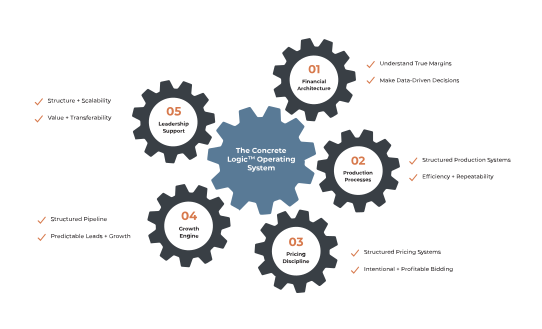

Know what your business actually earns
Most contractors maintain accounting systems primarily for tax reporting, not operational decision-making. As a result, leadership lacks timely insight into company performance. Without job-level financial visibility, it's impossible to know which projects are generating strong margins and which ones are quietly losing money.
- ·01 ✓ A standard chart of accounts designed specifically for contractor operations.
- ·02 ✓ Job costing systems that track labor, materials, and overhead at the project level.
- ·03 ✓ Margin targets and KPI dashboards that give leadership real weekly visibility into business performance.
- ·04 ✓ A monthly financial review process that transforms financial reporting from a compliance activity into a strategic management tool.
Concrete Logic helps you understand your real job margins, true gross profit, and what your business is actually worth, all without guesswork.

Measure what your crews can produce – and build around it
Contractor companies with weak production systems experience delays, inconsistent quality, and unpredictable project timelines. When leadership doesn't know crew output rates, it's impossible to price accurately, staff efficiently, or scale without things breaking.
- ·01 ✓ Measure crew output (square feet per day per worker), match labor cost to production, and identify the gaps between what your crews can deliver and what you're currently charging.
- ·02 ✓ Steven conducts on-site visits, using a 125-point inspection workbook, to observe operations, warehouse setup, and inventory firsthand.
- ·03 ✓ Introduce standardized scheduling frameworks, job workflows, and production metrics that give leadership real visibility into field performance.
A clear picture of your production capacity, a benchmark for crew performance, and the structured processes that let you add crews without creating operational chaos.

Stop pricing by intuition, start pricing by design
Most contractor estimates rely heavily on intuition rather than structured models. Contractors frequently reduce pricing to win projects — unknowingly sacrificing profitability. Many companies grow revenue while profit margins decline because pricing isn't anchored to what the business actually needs.
- ·01 ✓ A standardized estimating model grounded in your actual overhead structure, historical production data, and defined margin targets.
- ·02 ✓ Document pricing models and cost libraries so estimating knowledge becomes part of the company's system — not just an individual skill.
- ·03 ✓ Implement post-project estimate reviews that refine accuracy over time.
You'll price with confidence, protect your margins on every bid, and eliminate the guesswork that keeps profitable growth out of reach.

Create a more predictable pipeline
Most contractors rely almost entirely on relationships, referrals, and good luck for new work. These create unpredictable sales cycles and revenue that's impossible to plan around. Without structured marketing and sales systems, contractors have no control over what comes into the business next month.
- ·01 ✓ Once the financial, production, and pricing foundations are in place, you can safely activate demand generation, knowing it will lead to profitable growth. This includes full-funnel development, with everything required to move a prospect from first touch to closed deal.
Consistent inbound leads from the right type of clients, a sales pipeline you can actually forecast, and a growth system that doesn't depend on the owner to chase every opportunity.

Build a company that runs without you
In most contractor companies, the owner becomes the decision-maker for nearly every issue. As the business grows, this founder bottleneck makes growth stressful rather than exciting. Even worse, it also makes the business essentially unsellable, because it can't operate without the founder's constant presence.
- ·01 ✓ Establish role definitions, accountability structures, and management depth that distribute responsibility across the organization.
- ·02 ✓ Create leadership development pathways that prepare employees for management responsibilities.
- ·03 ✓ Prepare the owner for an eventual exit — whether that means stepping back, selling, or positioning for a strategic roll-up with private equity partners.
A company with real enterprise value that you could step away from, sell, or scale, all on your terms.